mardi 21 juillet 2026

The Odyssey (english)


A Monstrous Journey

     At first glance, Christopher Nolan's film disappoints its audience, whose dominant impression is one of an unnecessary and costly waste. Why ? Because it depicts a bleak, sad world without any heroism nor enthusiasm, a universe diametrically opposed to the luminous myth of Homer, betraying the epic, masterful and warlike story that one might have expected.


    But this would be to misunderstand the director's intention and the narrative coherence that governs his work.

    In Ithaca, ten years earlier, Odysseus left a harmonious kingdom, a simple and sincere life, a loving wife, an innocent son, and benevolent gods behind him.

    But war will shatter this harmony radically.

    The first culprit in this ongoing cataclysm is Agamemnon. Some critics have, somewhat hastily, compared his character to Darth Vader in George Lucas's "Star Wars." This reductive wink prevents us from grasping his true significance. Agamemnon, whose face, like Vader's, we never see, is not only a folkloric, power-hungry "villain"; he is evil incarnate, or, if you prefer, Death itself. The plume of his helmet, ending in the vertebrae of a skeleton, leaves no room for doubt on this point.


    Like Anton Chigurh in the Coen brothers' "No Country for Old Men," Agamemnon possesses two emanations. One symbolic (Death), the other embodied in reality (a psychopath). The latter is, of course, perishable.


    While Chigurh is gravely wounded, Agamemnon dies at the hands of his wife Clytemnestra, Helen's twin sister, who thus avenges the ignoble sacrifice of their daughter Iphigenia. Logically, the king of Mycenae finds himself in the Underworld. In this fascinating scene where Odysseus comes to submit to his "master" (sorry, his king), he is thus the embodiment of Death itself, reigning over his kingdom.

    Odysseus could not emerge unscathed from the complicity that binds the two characters. He is a man sick with himself, sick with his cunning, his intelligence, his own perfidy.


    The film opens, in fact, with the image of the wooden horse, conceived by Odysseus and built by the Greeks to deceive the besieged Trojans. Strangely, while it would have been much simpler to place it on a pedestal to facilitate its transport, we discover the horse half-buried in the sand of the beach, like the Statue of Liberty in Franklin J. Schaffner's "Planet of the Apes."


    Upon seeing the statue, Charlton Heston understands that the earth has been ravaged by the atomic bomb and declares, terrified: "They did it!" Nolan thus makes it clear from the very first images: the original cataclysm has already occurred. 

    This disaster is the ruinous war waged for ten years by the Greek armies under the authority of Agamemnon to reclaim Helen, kidnapped from her brother Menelaus. However, as Odysseus himself suggests, Helen is merely a convenient pretext concealing far less honorable intentions of territorial and commercial domination. By transforming the horse, an offering to Athena, into a motive for betrayal, enabling the rape, pillage, and complete destruction of Troy, Odysseus has committed a sin whose gravity he fully grasps and for which he will have to bear the consequences. The brisk, constant wind, the gray, cloudy sky, heavy as a pall, the snow, the successive storms—all these reflect the character of the gods who have seen and heard everything. The unleashed elements foreshadow a world in decay, where the sun, joy, and even laughter itself have been banished.

    From now on, the world will be unpredictable, the gods capricious, their manifestations monstrous and always ambivalent. 

    The Cyclops Polyphemus is just one example. His supposed (and quite visible) monstrosity is indeed coupled with a surprisingly gentle nature. Far from the garrulous, irascible, and furious giant of the myth, he is, in the movie, a peaceful shepherd, affectionate with his sheep and likely a vegetarian (he lives on cheese). Polyphemus, moreover, is not fiercely hostile to the strangers who have nonetheless forced their way into his lair, and if he indulges in tasting a few of them, it is more out of curiosity than appetite, for their flesh elicits an understandable grimace of disgust from him.

    The arrival of Odysseus and his companions on the island of the Laestrygonians follows the opposite pattern. The travelers encounter a child, a symbol of innocence, but of abnormal size. Upon seeing them, the child lets out a cry of terror of a length and intensity equaled only by one other cinematic voice: that of Oskar in Volker Schlöndorff's "The Tin Drum," a noisy and ludicrous protest against a world gradually descending into the horror of fascism.


    As we have seen, the cosmic balance that reigned between Men and Gods is indeed disrupted and, to put it bluntly, broken.

    The sorceress Circe, at whose home Odysseus and his companions later find refuge, confirms this. Here, Circe is not the enchanting creature evoked by the myth, but a harsh and cunning peasant woman who transforms everything into its opposite. According to what Circe herself tells Odysseus, before their metamorphosis, the magnificent felines that lay along the path leading to her cottage were probably hideous men. Courageous and loyal, Odysseus's companions will thus be transformed into pigs. 

    The collection of deformities resulting from this terrible disharmony of the world would not be complete without mentioning the monster Scylla, who devours six of Odysseus's companions, and, even more disturbingly, the face of Helen herself, whose beauty Menelaus praises on one side and whose disfigured ugliness he deplores on the other side. 

    In this world plunged into chaos, the word of the gods who once advised humankind has become inaudible. As proof, there is the song of the sirens, which Nolan cleverly spares the viewer by having them plugged with wax. Odysseus, however, insists on submitting to their temptation. Like a pilgrim lost on the path to his own redemption, he will retain a bitter and painful memory of it. This allusion to Christ and the trials the devil places into his path will gradually intensify.

    The different stages of the Odyssey indeed suggest the Stations of the Cross, and, like Christ, Odysseus will be provided with twelve companions, or, if you prefer, twelve apostles. In his quest for redemption and his search for a way back to his homeland, Odysseus constantly questions the gods, but finds their words difficult to interpret. And these are not only the gods of the Pantheon. 

    Laying the groundwork, in his own way, for a possible shared history of the great universal religions in the cradle of myth and antiquity, Nolan does not, in fact, invoke Christianity alone. The prohibition against eating pork, which Odysseus observes, is an explicit allusion to Islam. His excessive consumption of lotus flowers at the nymph Calypso's, on the other hand, allows him to achieve inner peace through oblivion, or more precisely, ataraxia—a direct allusion to Buddhism.

    Exasperated, Odysseus finally acknowledges that the gods are no longer of any help to him. From now on, he will have to manage his own way. As in the episode of Charybdis and Scylla, lacking the best path, he decides to choose the lesser of two evils. The gods, whom he defies with his attitude, have abandoned him. Their world is decidedly too vast, their decisions indecipherable. By restoring this world to more just proportions, to human proportions, Odysseus will finally be able to control his destiny. 

    Like Christ driving the money changers from the temple, he repels the suitors who throng around Penelope and cleans house in his kingdom. Locked with them in the throne room, misfortunes no longer fall from the sky, but only from the ceiling. It is a challenge worthy of him, which he overcomes without too much injury, except, like the martyr Saint Sebastian, a career soldier who also performed miracles, for a few arrows.


    If the balance of the cosmos has been broken, the balance of Ithaca (where, as if by magic, the sun has returned) will be restored by the courage and sacrifice of Odysseus, by the fidelity of Penelope, and by the commitment of her son Telemachus.


    As we can see, Christopher Nolan's Odyssey is not a flamboyant movie. It is a twilight quest, coherent and often desperate, that attempts to restore a form of equilibrium and brings the light of reason to a world that has already plunged into darkness and, perhaps, into obscurantism.


lundi 20 juillet 2026

L'odyssée (french)


Un monstrueux voyage

À priori, le film de Christopher Nolan surprend et déçoit. À la sortie, l'impression qui domine le spectateur est celle d'un gâchis inutile et coûteux, la peinture d'un monde morne, blafard, dont on aurait effacé tout aspect héroïque et tout enthousiasme, d'un univers situé à l'opposé du mythe lumineux d'Homère, du conte épique, magistral et guerrier qu'on serait en droit d'attendre. 

Mais ce serait se tromper sur l'intention du réalisateur et sur la cohérence narrative qui domine son oeuvre. 

À Ithaque, dix ans plus tôt, Ulysse a laissé derrière lui un royaume harmonieux, une vie simple et sincère, une épouse aimante, un fils innocent, des dieux bienveillants. 

        Mais la guerre va briser cette harmonie de façon radicale. 

Le premier responsable du cataclysme en cours est Agamemnon. Certains critiques ont, un peu facilement, rapproché son personnage de celui de Dark Wador dans "La Guerre des étoiles" de George Lucas. Ce clin d'oeil réducteur empêche de mesurer sa véritable importance. Agamemnon dont, comme Vador, on ne verra pas le visage, n'est pas un simple "méchant" folklorique et avide de pouvoir, c'est le mal incarné ou, si l'on préfère, la Mort. Le panache de son heaume, terminé par les vertèbres d'un squelette, ne laisse aucune ambiguïté sur ce point. 


    À l'image d'Anton Chigurh dans "No Country for old men" des frères Cohen, Agamemnon possède deux émanations. L'une symbolique (la Mort), l'autre incarnée dans le réel (un psychopathe). Cette dernière est évidemment périssable. 


        Si Chigurh se blesse gravement, Agamemnon, lui, décède sous la main de son épouse Clytemnestre, sœur jumelle d'Hélène, qui venge ainsi l'ignoble sacrifice de leur fille Iphigénie. Logiquement, le roi de Mycènes se retrouve aux Enfers. Dans cette scène fascinante où Ulysse vient faire soumission à son "maître" (pardon, à son roi), il est donc l'incarnation de la Mort elle-même régnant sur son royaume.

Ulysse ne pourra pas sortir indemne de la complicité qui les lie. C'est un homme malade de lui-même, malade de sa ruse, de son intelligence, de sa propre perfidie. 

Le film s'ouvre en effet sur l'image du cheval de bois, imaginé par ses soins, et construit par les grecs pour tromper les troyens assiégés. Etrangement, alors qu'il aurait été bien plus simple de le faire reposer sur un socle pour faciliter son transport, on découvre le cheval à demi enseveli dans le sable de la plage, comme la Statue de la Liberté dans "La Planète des Singes" de Franklin J. Schaffner. 


        En voyant la statue, Charlton Heston comprend que la terre a été ravagée par l'arme atomique et déclare, terrorisé : "Ils l'ont fait !". Nolan nous l'indique donc clairement dès les premières images, le cataclysme originel a déjà eu lieu. 

Ce désastre, c'est la guerre ruineuse menée depuis dix ans par les armées grecques sous l'autorité d'Agamemnon pour reprendre Hélène kidnappée à son frère Ménélas. Or, comme le suggère Ulysse lui-même, Hélène n'est qu'un prétexte commode qui cache des intentions de domination territoriale et commerciale beaucoup moins louables. En transformant le cheval, offrande à Athéna, en motif de trahison permettant le viol, le pillage et la destruction complète de Troie, Ulysse a commis une faute dont la gravité ne lui échappe pas et dont il devra assumer les conséquences. Le vent vif et constant, le ciel gris, nuageux, pesant comme une chape, les tempêtes successives sont à l'image du caractère des dieux qui ont tout vu, tout entendu. Les éléments déchaînés présagent d'un monde en délitescence ou le soleil, la joie, le rire lui-même auront été bannis.

Désormais, le monde sera imprévisible, les dieux capricieux, leurs manifestations monstrueuses, et toujours ambivalentes. 

Le cyclope Polyphème n'est en qu'un exemple. Sa monstruosité supposée (et bien visible) se double en effet d'un caractère étonnamment doux. Loin du géant bavard, irascible et furieux du mythe, c'est, dans le film, un pâtre paisible, affectueux avec ses brebis et vraisemblablement végétarien (il se nourrit de fromage). Polyphème ne se montre d'ailleurs pas farouchement hostile aux étrangers qui ont pourtant forcé l'entrée de son repaire et, s'il se laisse aller à en goûter quelques-uns, c'est plus par curiosité que par appétit, car leur chair lui tire un rictus de dégoût compréhensible. 

L'arrivée d'Ulysse et de ses compagnons sur l'île des Lestrygons emprunte un mécanisme inverse. Les voyageurs rencontrent un enfant, symbole d'innocence, mais de taille anormale. En les apercevant, l'enfant pousse un cri de terreur d'une longueur et d'une intensité dont le cinéma ne possède qu'un seul équivalent, celui d'Oskar dans "Le Tambour" de Volker Schlöndorff, protestation bruyante et dérisoire contre un monde qui bascule peu à peu dans l'horreur du fascisme. 


On l'a compris, l'équilibre cosmique qui régnait entre les Hommes et les Dieux est bel et bien détraqué et, pour tout dire, rompu.

La magicienne Circé, chez qui Ulysse et ses compagnons vont échouer ensuite, va le confirmer. Ici, Circé n'est pas la créature enchanteresse évoquée par le mythe, mais une paysanne rugueuse et fourbe qui transforme toute chose en son contraire. D'après ce que Circé elle-même confie à Ulysse, avant leur métamorphose, les félins magnifiques qui gîtent sur le chemin menant à sa chaumière étaient probablement de hideux personnages. Courageux et fidèles, les compagnons d'Ulysse se verront donc transformés en porcs. 

La collection de difformités qui résulte de cette terrible dysharmonie du monde ne serait pas complète sans évoquer le monstre Scylla qui dévore six compagnons d'Ulysse et, plus troublant encore, le visage d'Hélène, dont Ménélas loue la beauté d'un côté et déplore la laideur défigurée de l'autre. 

Dans ce monde plongé dans le chaos, la parole des dieux qui conseillaient autrefois les Hommes est devenu inaudible. Pour preuve, le chant des sirènes dont, astucieusement, Nolan épargne le spectateur en lui imposant des bouchons de cire. Ulysse, lui, exige de se soumettre à leur tentation. Semblable à un pèlerin égaré sur le chemin de sa propre rédemption, il en gardera un souvenir amer et douloureux. Cette allusion au Christ et aux épreuves que le diable dispose sur sa route va se renforcer peu à peu.

Les différentes étapes de l'Odyssée suggèrent en effet les stations du Chemin de croix et, comme le Christ, Ulysse sera pourvu de douze compagnons ou, si l'on préfère, de douze apôtres. Dans sa quête de rédemption et sa quête d'un chemin de retour vers sa patrie, Ulysse ne cesse d'interroger les dieux, mais constate que leurs paroles sont difficiles à interpréter. Or il ne s'agit pas seulement des dieux du Panthéon. 

        Posant à sa manière les jalons d'une possible historicité commune des grandes religions universelles dans le berceau du mythe et de l'antiquité, Nolan ne convoque pas le seul christianisme en effet. L'interdiction de consommer du porc, qu'Ulysse respecte, est une allusion explicite à l'Islam. Sa consommation excessive de fleurs de lotus chez la nymphe Calypso, à l'inverse, lui permet d'atteindre la paix intérieure par l'oubli ou, plus exactement, l'ataraxie, une allusion directe au bouddhisme.

Exaspéré, Ulysse finit par reconnaître que les dieux ne lui sont plus d'aucun secours. Désormais, il devra se débrouiller seul. Comme dans l'épisode de Charybde et Scylla, à défaut du meilleur chemin, il lui faudra choisir le moins pire. Les dieux, qu'il défie par son attitude, l'ont abandonné. Leur monde est décidément trop vaste, leurs décisions indéchiffrables. En ramenant ce monde à de plus justes proportions, des proportions humaines, Ulysse va être enfin en mesure de contrôler son destin.

À l'image du Christ chassant les marchands du temple, il repousse les prétendants qui se pressent auprès de Pénélope et fait le ménage dans son royaume. Enfermés avec eux dans la salle du trône, les malheurs ne lui tombent plus cette fois du ciel, mais uniquement du plafond. C'est un défi à sa hauteur, qu'il surmonte sans trop de blessures, si ce n'est, comme le martyr saint Sébastien, militaire de carrière ayant lui aussi accompli des miracles, percé de quelques flèches. 


        Si l'équilibre du cosmos a été rompu, celui du royaume d'Ithaque (ou, comme par magie, le soleil est revenu) sera restauré par le courage et le sacrifice d'Ulysse, par la fidélité de Pénélope et le dévouement de son fils Télémaque.


On le voit, l'Odyssée de Christopher Nolan n'est pas un film flamboyant. C'est une quête crépusculaire, cohérente et souvent désespérée qui tente de rétablir une forme d'équilibre et d'apporter les lumières de la raison a un monde qui a déjà basculé dans l'obscurité et, peut-être, dans l'obscurantisme.


lundi 20 janvier 2014

The Lord of the Rings (english)


                         A thirteen months' quest : annus horribilis


Thanks to its visual inventiveness, Peter Jackson's movie has been usually regarded as one of the greatest artistic achievements of the 2000s. As a matter of fact, it is difficult to focus on it, for at least four reasons : 
1) any critical analysis is likely to ruin the "magic" which it is built on, and on which its success depends in part,
2) the movie is based upon a strong literary basis which first vehicles the ideas of J.R.R. Tolkien (author of the original book, which we do not have to talk about), 
3) P. Jackson turns this narrative material into a myth which carries his own concerns,
4) P. Jackson is not S. Spielberg, his baby seems to escape his conscious control sometimes, giving birth to a stange creature reflecting the contradictions of several distinct wills (Tolkien/Jackson) without being able to solve any of them. 

We will not spend time on the movie's historical (medieval/fantasy) context nor on its narrative progress : a group of different characters join their forces so as to make an evil ring (which could possibly lead the world to its own ruin) disappear.


Reading such a plot at a basic level only provides, at best, confirmation of a chivalric code stirring quite outdated moral virtues (mutual respect, brotherhood courage, hope, toughness and, we'll see how important it is- chastity). It also reminds us of traumatic memories from History, when democracies allied against dictatorship were rescued but in-extremis (the book "The Lord of the Rings" was published just ten years after WW 2). 

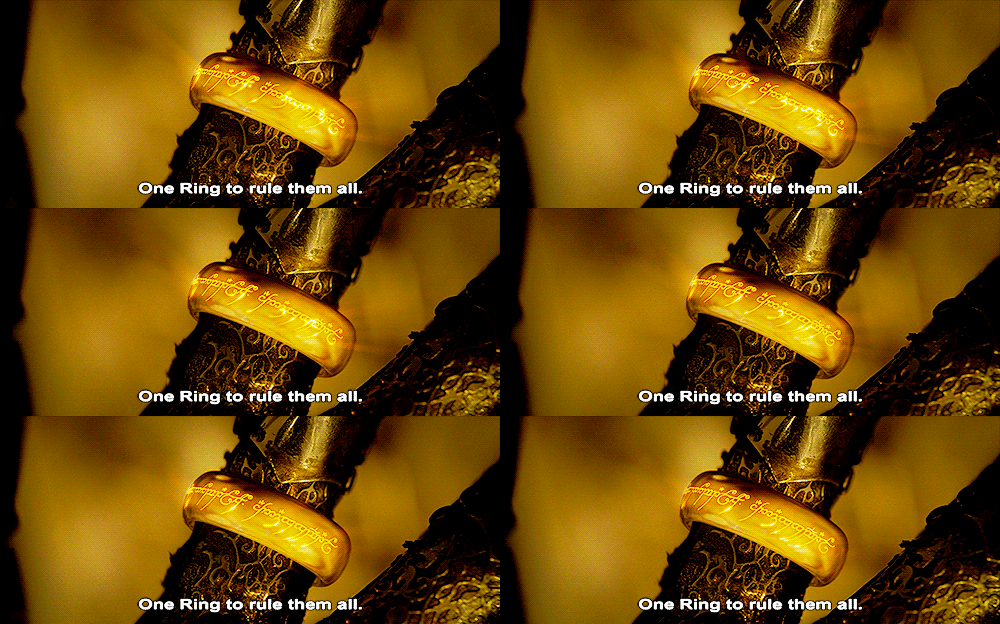
Let's take an apparently banal scene to help measuring the interpretative challenges ahead : at the begining of the film, the wizard Gandalf and Bilbo the Hobbit smoke their pipe altogether, shortly before a Hobbit ceremony.


Bilbo produces a very successful ring of smoke. Gandalf, who prides himself to do better, blows a splendid ship of smoke sailing through the night. 
A first level of interpretation suggests that :
   - the ring of smoke symbolizes the Ring that Bilbo secretly hides in his pocket, 
   - the ship of smoke anticipates the real ship that will carry Bilbo to the unkown - his death- in the final scene of "The return of the King" .

A second level of interpretation reminds us that Gandalf and Bilbo share a common (hi)story (the one Peter Jackson's following trilogy - "the Hobbit" - laboriously tries to tell us) as well as a great complicity which does not need any word to be expressed.  When adults are together, sex is a very common, even if not unequivocal, topic. Bilbo, whose 111th birthday is celebrated, boasts of still being green and healthy, suggesting that he has lost none of his physical, therefore sexual ability, an ability which Gandalf admires. As a consequence, the magician is eager to show his challenger that he is provided with an equal and even greater sexual ability.

By the way, it is quite disturbing to admit that  The Lord of the Rings is overwhelmed by males (men, elves, dwarves, various creatures) or, in other words, that it is almost completely devoid of women. It is therefore tempting to explore the trail of a ring taken in its most common sense, that is to say as a marital union (marriage). Indeed, we know nothing about Frodo's parents, about Lord Elrond of Rivendell's wife, about King Theoden of Rohan's wife, about Denethor of Gondor's one. We know nothing about Gimli's or Legolas' wifes either (if there is any to be found out), etc. In fact, and this is quite unique and extraordinary, absolutely none of the characters in this film seems to be married. The story takes care to erase any trace of union with a woman.

If the ring symbolizes marriage, then for the Tolkien/Jackson couple, marriage is undoubtedly evil.
The different occurences of the circular shape clearly suggets it : this is the natural formation of the orks all around the community members in the mines of Moria (film 1), and once more during the final battle at the gate of Mordor (film 3), this is the shape of the ruins over the Mont-Weathertop where Frodo is wounded, this is the shape of the Elven fountain in which Frodo discovers with horror the future of pein and slavery promised to the Hobbits if the ring is not destroyed. 


Then it's impossible not to recognize that the one that embodies evil, Sauron, is also the only one to have and to be able to exhibit the attributes of both a male and a female :
   - his finger wearing the ring in the general introduction,
   - the tower of Barad-Dur topped by an eye whose shape evokes an incredible giant vulva. 
In this context (marriage considered as Evil), it becomes natural that Sauron has the qualities of both types (re)united and that he uses them to terrorize the creatures he intends to submit because they try to resist him by their celibacy. 


Anyhow, this interpretation suffers from several flaws :
   - how to understand the circle formed by the members of the different communities reunited in Elrond's Rivendell to decide what to do with the ring ?
   - how to explain that, after the victory, Aragorn quickly celebrates his union with the elf Arwen ?
   - how to consider the final wedding of Sam Gamgee and the Hobbit waitress Rosie ? 

Let's go back to the scene with the smokers.
The ship of smoke blown by Gandalf doesn't only sail through the night, it also sails through Bilbo's circle of smoke, suggesting an explicit sexual act.  If it would be reckless to conclude that these two characters have, or have had in the past physical relations, but it forces us to rethink the entire movie, at least. 


Because, in the world of chivalry created by Tolkien and revisited by Jackson, women do not appear as potential companions. The few ones who escape this general ostracism by the importance given them by the story are only three :
   - the elf Galadriel, a witch doted with feared powers,
   - the elf Arwen, an inaccessible icon, a noble lady from the Middle Ages whom Aragorn loves in a strictly platonic and friendly way, 
   - King of Rohan's niece Eowin, whose feminine nature is contradicted by is willingness to enter the fight disguised as a man.

In other words, in The Lord of the Rings, a male character who intends to relieve his natural impulses has but one alternative : to hope to conquer the heart of a noble lady, like a knight of old times (but there is no guarantee it will be enough to satisfy his desires, unless in a legal framework and so as to ensure offspring, like Aragorn and Arwen), or to to succumb to the obvious temptation of a homosexual relationship. 
Tolkien/Jackson warn us that there is no other choice. 


Now, it becomes necessary to look at the case of the main hero of the story : Frodo Baggins.
In many ways, Tolkien/Jackson suggest that Hobbits are, because of their size, their way of life, their bonhomie, their naivety, nothing but chidren. By the way, when they want to make fun at them, don't other people call them semi-men ?  
If Frodo proves to be a mature and reasonable boy, if Sam appears like an excellent companion, Merry and Pippin are known for their pranks. The initiatory journey that will lead Frodo from the verdant hills of the Shire to the emaciated reliefs of Mordor is the opportunity to lead all these characters from childhood to adulthood and therefore to determine their sexual preference. 

By the way, it is necessary to note the important role played by Gandalf in this quest.
The magician soon establishes himself as a a benevolent and credible alternative father : he is the one into the arms of whom Frodo throws himself at the begining of the film, he is the one who offers his advice, the one who guides and persuades the community. He is the holder of the History of the County (he has access the the archives) he has got a long wooden cane (a phallic object) which confers him magical powers and, on occasion, he gets angry and rages against scamps (he draws Pippin and Merrys' ears and forces them to do the disches). Disappearing in the mines of Moria, Gandalf deprives the Hobbits of the light that illuminated their path, letting them plunge into the dark forces of evil (where night dominates everything).


During this long journey, the physical integrity of Frodo will be jeopardized five times.
He will suffer from :
- 3 penetrating wounds (2 successful ones : the king's sword-sorcerer Angmar on Weathertop, the poisoned sting of the spider Arachne, an a failed one : the spear of a troll in the cavern of Moria, which could have "pierced a boar" dwarf Gimli says),
   - an attempt to ingest him (the giant octopus at the entrance of Moria, whose round mouth is rimmed with teeth),
   - an amputation (the index bearing the ring, severed by the teeth of Gollum on Mount Doom). 

Among theses different tests, the first one and the last one will be critical. 
Any penetration (and there are many in the film : penetration of the community into the mines of Moria, penetration of the skeleton into the well, penetration of the Uruk-hai into the fortification of Helm's Deep), paves the way to the manifestation of evil and must be interpreted as a sexual act. When suffered by the victim, it is legitimate to compare it to a symbolic rape.
The rape suffered by Frodo will affect his libido and his future sexual preferences (the ambiguous caresses he regulary gives to Sam during his trials leave no doubt on this point). Because if Frodo is continuously coveted, this is not only because he has the ring, but because this ring is a very different attribute of Man. 


In this perspective, the finger of Sauron in the prologue of the trilogy should be reinterpreted.
Sauron does not wear a male attribute (the finger) and a female attribute (the ring), but rather two attributes of the same sex. And this is precisely why, homophobic considerations aside, it is evil. And that is why, castrated by the sword of Isildur, he loses all his powers. 

Frodo himself is quickly confronted with the alternative mentioned above and must face the facts : his is not a ring bearer but an anus bearer (in french, the etymology of the two words are very close "anneau/anus"). And this anus is either an object of desire for some creatures, either an object of defiance for himself. 

Taken this hypothesis for truth, the film reaches its true dimension. 
The Evil multiplies phallic objects (tower of Sauron, Saruman tower, tower of Cirith Ungol, the slimy arms of the octopus, the long neck of the Nazgul) and threatens the people of Middle-Earth (another axis which converges to the center) by a surrounding strategy shaped like an circle, that is to say an anus (see all evil circular formations already noted). 

In this context, Peter Jackson transforms the simple initiatory journey of Frodo into an unprecedented epic, a wonderful way of  renunciation requiring exceptionnal strength of mind. For, since he has been injured, Frodo has understood the nature of the evil in himself. Like a renunciating monk of the Middle Ages, he decides to sublimate his homosexuality and, suffering differents ordeals, puts himself at the service of a chivalrous upper cause : a sublime chastity thought to be an example to the world (remember that union with a woman is not seen as a possible emergency exit).


Moreover, we must not misinterpret Sauron's willing. Despite the countless battles included in the trilogy, Sauron doesn't intend to impose his domination to the world by force. His rule will impose itself if the ring is not destroyed. Which way ? 
The filthy creatures issued from the underground or Orthanc (magician Saruman's home) can give clear idea of it. This is at the foot of the tower (the phallus), inside the underground of it (the balls), that Saruman gives birth to spontaneous generations of unisex monsters. What threatens the world is not the ring itself, but the prospect of a world in which the relationship between creatures of the same sex would lead to a natural and inevitable extinction of all other species. 


 Therefore, to destroy the ring/anus means to escape the fate of a world where homosexuality would not only be the norm, nor even a duty, but a full and absolute servitude. 

Despite his fierce determination and the nobility of his fellings, Frodo won't finally escape the temptation which harasses him. Note that the ring gives, when put on one's finger, a strange power of invisibility. In other words, when completed, the homosexual act immediately plunges its author into hiding (others can not / should not see it). It is a taboo. It gives a strong sens of guilt (vulvar eye of Sauron). 
At the end of his journey, Frodo succumbs, puts the ring on and decides to keep it. Facing this potential disastrous threat for the world, Tolkien choses the only radical solution : castration. 


The ring is not simply removed by Gollum, but torn out by teeth from the index bearing it, recalling the fate of Saint Origen, one of the Fathers of the Catholic Church, the rigidity of principle and moral of whom had driven him to auto-castrate to avoid any temptation.


The future of (Saint) Frodon the eunuch is written in advance : he will become a monk-copyist to tell his adventures. 

To Frodo's castration replies the Nazgul's castration in the final battle at Minas Tirith. The ambiguity here is at its peak. To destroy the Witch-King, a blade (phallus) is inserted into the oval black (anus) of his face by a woman, Eowin, disguised as a man. 

For Tolkien, people (men) gathered altogether constantly face the evil of a mutual attraction leading to a dead end (this is the circle of the different communities in Rivendell).
Successfully overcome this evil requires honesty and renunciation. Giving it up exposes the mind to the horror of a schizophrenic and hopeless struggle which will alternate delivery phases and libidinous excitement : this is the case of Gollum. 

But as soon as the ring/anus is destroyed and the world set free from its dilemma (homosexuality/chastity), love is able to come back (a courteous  love for Aragorn, a carnal love for the Hobbits having reached adulthood). 
Sam Gamgee, although a punctual ring bearer who never had the temptation to put it on, can legitimately claim Rosies's hand and reveal the perspectives of the new world to come : an abundant maternity (this is the ultimate and splendid scene selected by Jackson to complete his trilogy). The children of Sam and Rosie get out the round belly of the little house in the County reminding us of the round belly containing our latent Humanity  in the last scene of Quest for Fire by Jean-jacques Annaud.
(Well, in french, "Annaud" means "ring" !…quite disturbing, isn't it ?)


The Lord of the Ring is based upon a strong moral imperative embodied by Frodo, and whose echo comes from a rigorist past one would have thought over. Nevertheless, it has found, quite inexplicably, a sympathetic ear among our contemporaries.